
Mutual Funds vs ETFs: Which is Better for You?
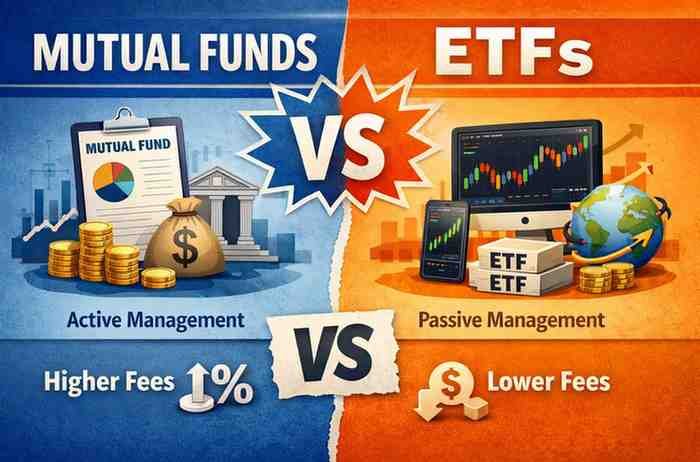
When it comes to investing, two of the most popular options for beginners and experienced investors alike are Mutual Funds and Exchange-Traded Funds (ETFs). Both allow investors to diversify their portfolios and grow wealth without directly picking individual stocks — but they work in different ways.
If you’re confused about which one suits your financial goals better, this guide will help you understand the key differences, pros, cons, and ideal use cases of mutual funds and ETFs.
1. What Are Mutual Funds?
A mutual fund pools money from multiple investors to invest in a diversified portfolio of stocks, bonds, or other securities. The fund is managed by a professional fund manager who makes buy and sell decisions on behalf of investors.
Example:
If you invest in a mutual fund like SBI Bluechip Fund, your money is combined with others’ and invested in large, stable companies.
Types of Mutual Funds:
-
Equity Mutual Funds
-
Debt Mutual Funds
-
Hybrid Funds
-
Index Funds
Ideal For:
Investors who prefer a hands-off, professionally managed approach.
2. What Are ETFs (Exchange-Traded Funds)?
An ETF is similar to a mutual fund but trades like a stock on an exchange (such as NSE or BSE). ETFs typically track a market index — like Nifty 50 or Sensex — and aim to replicate its performance.
Example:
If you buy a Nifty 50 ETF, you’re investing in all 50 companies that make up the Nifty index.
Types of ETFs:
-
Index ETFs
-
Gold ETFs
-
Sector ETFs
-
International ETFs
Ideal For:
Investors who want low-cost, flexible, and transparent investments that can be traded in real-time.
3. Key Differences Between Mutual Funds and ETFs
| Feature | Mutual Funds | ETFs |
|---|---|---|
| Management | Actively or passively managed by fund managers | Mostly passive (track an index) |
| Trading | Bought or sold at end-of-day NAV | Traded like a stock during market hours |
| Costs | Higher expense ratios (due to active management) | Lower expense ratios |
| Minimum Investment | Usually ₹500 – ₹1,000 (via SIP) | Price of one ETF unit (depends on market price) |
| Liquidity | Lower (can’t sell instantly) | Higher (can sell anytime during trading hours) |
| Transparency | Portfolio disclosed monthly or quarterly | Portfolio visible daily |
| Taxation | Similar to ETFs (depends on holding period) | Similar to mutual funds |
4. Advantages of Mutual Funds
✅ Professional Management:
Your investments are handled by expert fund managers.
✅ SIP Option:
You can invest small amounts regularly through Systematic Investment Plans (SIPs).
✅ Variety of Choices:
From equity to hybrid and debt funds — mutual funds suit every risk appetite.
✅ Great for Beginners:
You don’t need market knowledge to get started.
5. Advantages of ETFs
✅ Lower Cost:
ETFs usually have lower management fees and expense ratios.
✅ High Liquidity:
You can buy or sell ETFs anytime during market hours.
✅ Transparency:
Holdings are publicly available every day.
✅ Better for DIY Investors:
If you understand markets and want control, ETFs give you flexibility and efficiency.
6. Disadvantages to Consider
Mutual Funds:
-
Slightly higher fees (especially active funds).
-
No control over daily trading price (transactions occur only once a day).
-
May underperform their benchmark if managed poorly.
ETFs:
-
No SIP feature (though some brokers offer indirect methods).
-
Requires a Demat account and some market understanding.
-
You pay brokerage on every trade.
7. Taxation: Mutual Funds vs ETFs in India
The taxation rules for mutual funds and ETFs are similar since both are market-linked instruments.
Equity Funds / Equity ETFs:
-
Short-Term (less than 1 year): 15% tax on profits.
-
Long-Term (more than 1 year): 10% tax on gains exceeding ₹1 lakh per year.
Debt Funds / Debt ETFs:
-
Taxed as per income slab, with no indexation benefit (as per new 2023 tax rules).
So, taxation alone shouldn’t be the deciding factor — instead, focus on costs, convenience, and investment style.
8. Which One Should You Choose?
The answer depends on your investment goals, experience, and preferences.
Choose Mutual Funds If:
-
You’re a beginner who prefers expert management.
-
You want to invest small amounts regularly via SIP.
-
You value long-term stability and convenience.
Choose ETFs If:
-
You’re comfortable with stock trading and market timing.
-
You prefer low-cost, transparent, and flexible investments.
-
You want real-time control over buying and selling.
9. Can You Combine Both?
Absolutely!
A smart investor can use both mutual funds and ETFs for a balanced approach.
Example Strategy:
-
Use Mutual Funds for long-term goals (retirement, wealth building).
-
Use ETFs for short-term liquidity or tactical investments (like Nifty or Gold ETFs).
This hybrid strategy helps you enjoy the stability of mutual funds and the flexibility of ETFs.
Both Mutual Funds and ETFs are excellent tools for wealth creation — there’s no one-size-fits-all answer.
If you’re new to investing, start with mutual funds via SIPs to build consistency. As you gain confidence and market knowledge, consider adding ETFs for flexibility and diversification.
Remember:
“The best investment choice isn’t the one that’s most popular — it’s the one that fits your financial goals and risk tolerance.”